NeolemonNeolemonvsMidjourneyMidjourney

The same cartoon character, all the way through the book.

Midjourney is one of the best AI image generators in the world. We built Neolemon for the part of the job where one beautiful image isn't enough: keeping the same kid recognizable across page 1, page 8, page 17, and page 31.

20 free credits. No card required.

4.5
Trustpilot, 94% 5-star
Cartoon
consistency, one job
No
Discord required
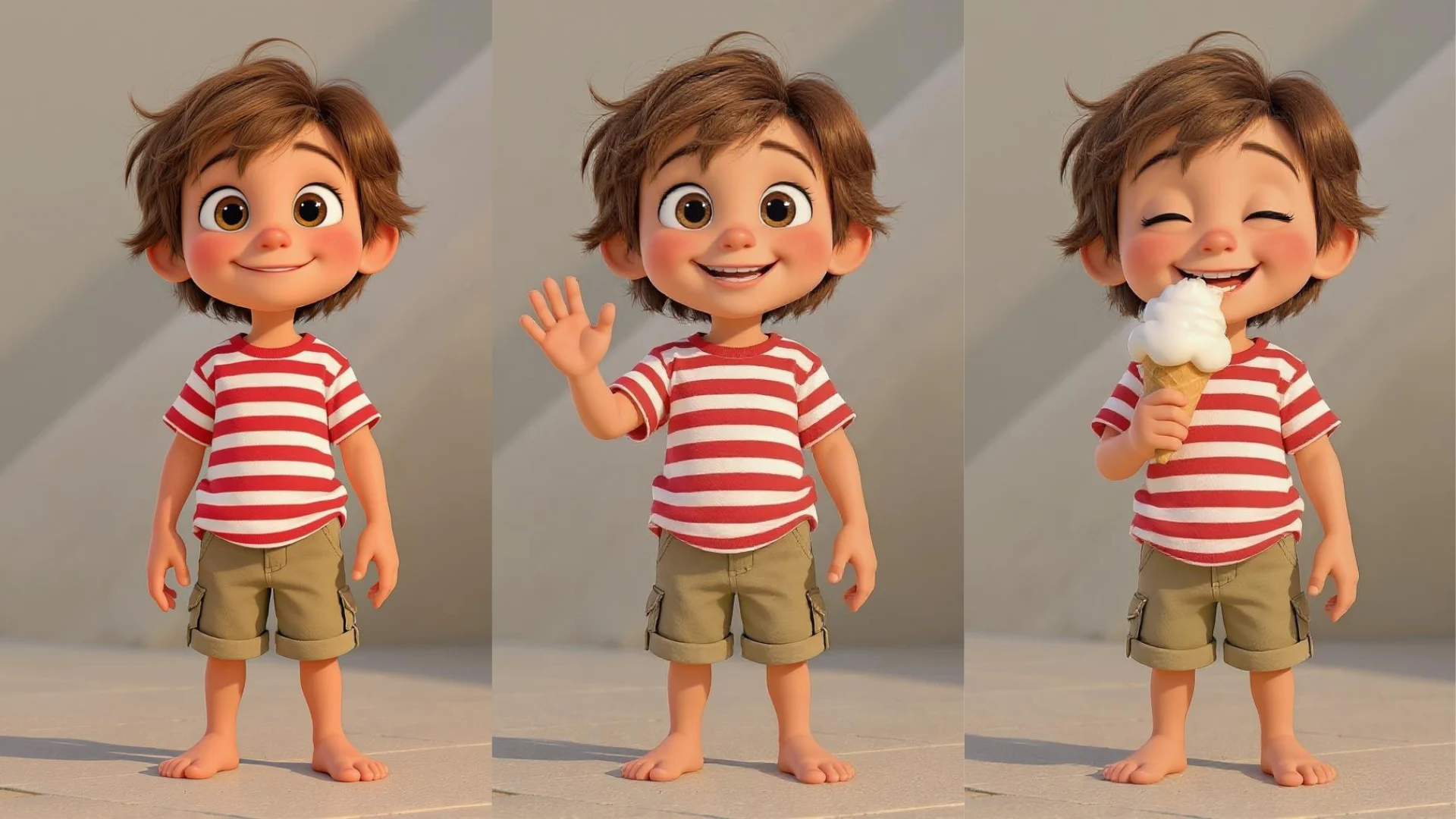
The same cartoon boy in three poses with an identical face, hair, and outfit

One character. Three poses. Zero drift.

The honest answer first

Who each one is for.

You already know Midjourney, or you're about to try it. Here's the fair split before any of the detail, so you can stop reading early if the answer is obviously one of them.

Choose Midjourney

You want the most beautiful one-off image: cinematic concepts, photoreal humans, anime via Niji, moodboards, cover art, broad visual exploration, or image-to-video. It's genuinely brilliant at all of it.

Choose Neolemon

Your job is the same cartoon character across many scenes: a children's book, a comic, a classroom mascot, a recurring brand character. Where the face has to keep showing up and stay on-model.

Use both

Explore the look and the cover in Midjourney, then lock the character and produce interior pages in Neolemon. Plenty of authors work exactly this way.

The short version

Midjourney vs Neolemon, at a glance.

If you only read one thing, read this. Where Midjourney is the stronger pick, the table says so plainly.

Midjourney Neolemon
Best forBeautiful one-off images, style exploration, photoreal humans, cinematic concepts, anime via Niji, image-to-videoThe same cartoon character across many scenes: children's books, comics, classroom stories, mascots, KDP picture books
Lowest paid tier$10/mo Basic (3.3 fast GPU hours, no Relax mode)$29/mo Creator (600 credits, about 150 Character Turbo generations)
Free trialNone on web or Discord (only the Niji mobile app)20 free credits, no card required
Character consistencyOmni Reference: V7 only, one reference image, 2x GPU cost, several incompatibilitiesThe entire product: Character Turbo plus dedicated editors for action, expression, outfit, perspective
Photoreal humansStrongNot the focus, cartoon-only since May 2025
Image-to-videoV1 Video, image-to-video, up to about 21 secondsFrames only, animate downstream in Runway, Kling, or Higgsfield
Privacy by defaultPublic and remixable unless on Pro ($60) or Mega ($120) with Stealth modeYour generations are yours
InterfaceWeb app plus DiscordWeb app, no Discord

Making one beautiful image? Stay with Midjourney. Making the same character appear on page 1, page 8, page 17, and page 31 of the same book? That's the line where we built Neolemon.

The whole comparison in one line

Midjourney is a taste engine. Neolemon is a memory layer.

Midjourney is optimised for surprising, gorgeous, taste-rich images. Storytelling is a different problem. It needs identity to persist while the pose, expression, outfit, and scene all change. That's not a beauty problem, it's a memory problem.

What a diffusion model does

Every image denoises from fresh random noise. Technically, each generation is a brand-new hallucination. That's exactly why the look surprises you, and exactly why your character drifts when you need it to stay the same.

What a story needs

The same face, hair, outfit, proportions, and art style, holding steady from page 1 to page 32 while everything around them changes. Neolemon is built around that one requirement instead of fighting the model for it.

Midjourney asks "what image do you want?" Neolemon asks "who is the character, and what should change while the character stays the same?"

What you're comparing

Two tools, two jobs.

Most "Midjourney alternative" listicles get this wrong. Here is precisely what each one is, as of 2026.

Midjourney

Midjourney

A general-purpose image and video model

A community-funded research lab of about 60 people, building one of the most capable image models in the world. The product runs across the web app and Discord, and the mental model is prompt-first.

  • Deep style surface. Style Reference, Moodboards, Personalization, Raw mode, and Niji for anime put real art-direction power in your hands.
  • A broad model stack. V8.1 is the newest and fastest with 2K HD output, V7 carries Omni Reference, and the Editor still runs on V6.1.
  • Now with video. V1 Video turns a still into a short clip. It's a stepping stone toward 3D and world models, not a story-production suite.

In their own words: founder David Holz has called Midjourney "an engine for the imagination." That framing is still accurate, and it's why the product is wonderful at exploration and not built around production workflows.

Neolemon

Neolemon

A consistent-character workshop

Formerly ConsistentCharacter.ai. We don't sell access to a general model. We sell the workflow you need when the job is "this character, in twenty situations, still recognizable."

  • Character Turbo anchors identity from structured fields for description, action, background, and style.
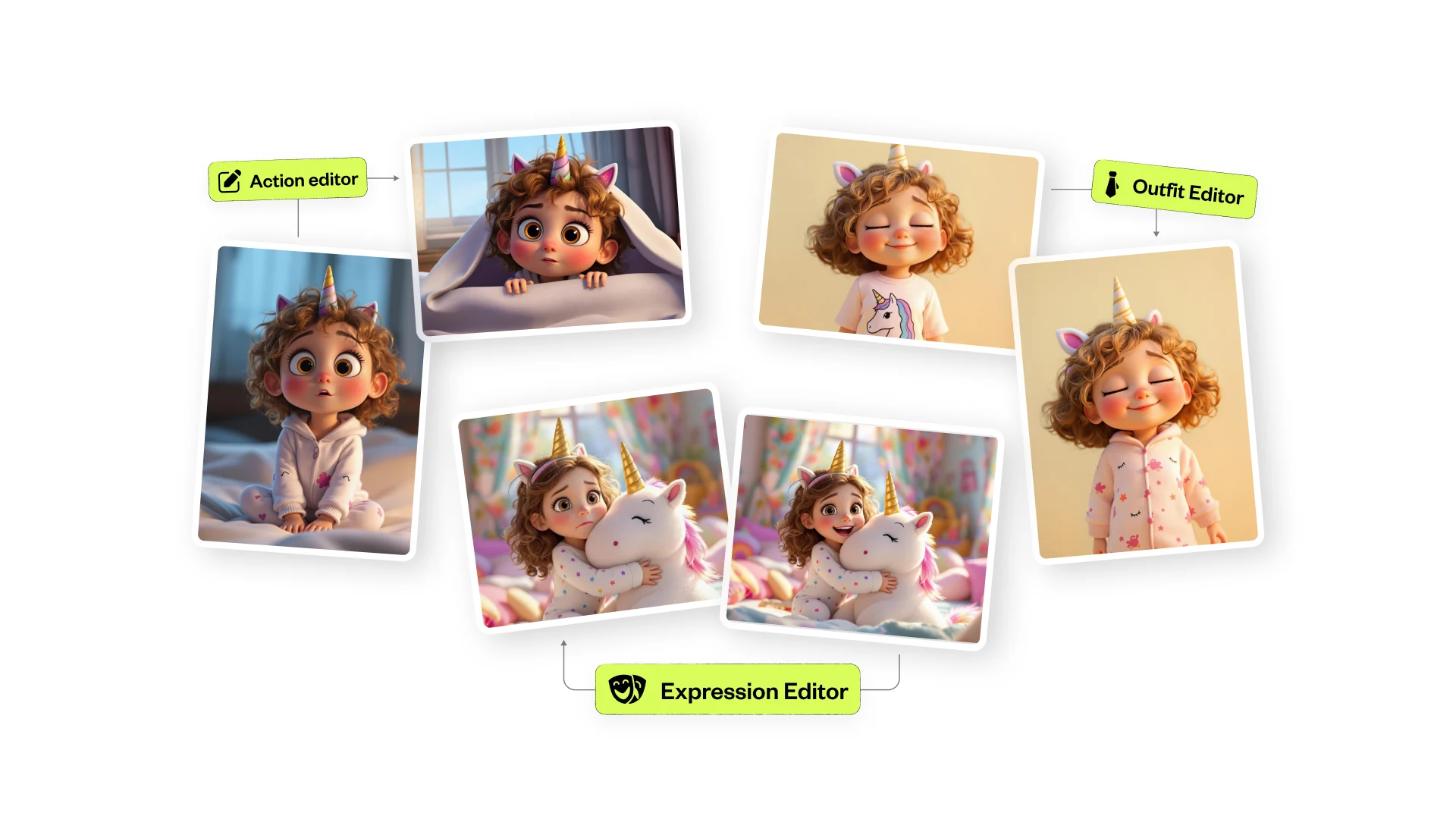
  • Action, Expression, Outfit, Perspective editors change one thing while the face, outfit, and style stay locked.
  • Multi Character and Story Scene Pro compose up to three characters with a background.
  • AI Canvas, Coloring Book Creator, Storyboard, PDF Export take you from one character to a laid-out book.
Neolemon editors generating the same character in different poses and outfits

How consistency actually works

Lock the identity. Change everything else.

Any model can make one cute character. It falls apart around page 20, after your hero has been re-rolled into thirty new scenes and quietly stopped being the same kid. Neolemon never re-rolls the character itself.

1

Anchor

One clean front view in Character Turbo. Every scene from here on derives from this single reference.

2

Pose it

Action Editor changes the pose. Face, outfit, and style stay exactly where they were. Free upscaling included.

3

Emote it

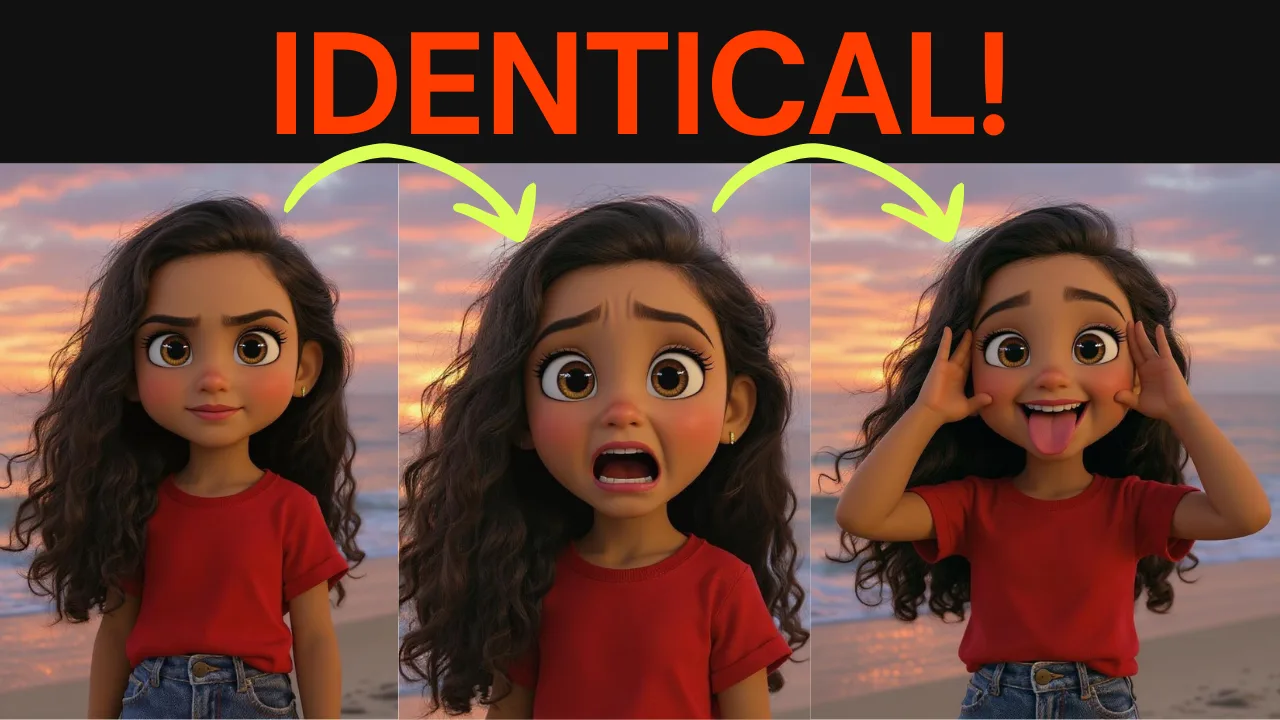
Expression Editor moves head tilt, eyes, brows, and mouth. Same child, twelve different feelings.

4

Compose it

Drop the character into a background, or compose several with Story Scene Pro. No identity blending.

The same cartoon girl in three expressions, labelled identical

Why it holds where general models drift

The design philosophy is the separation itself. The identity fields stay clean while the scene fields change, so the model gets a clear signal about what should hold steady. You never touch seeds, ControlNet, LoRA, or which model version supports which feature.

The same approach powers the developer model on Segmind, consistent-character-AI-neolemon-v3: a character reference plus an optional pose reference. It's a workflow for controlling consistency, not a wish for it.

The obvious objection

"But Midjourney has Omni Reference now."

It does, and we won't pretend otherwise. Omni Reference can carry a character, object, vehicle, or creature from one reference image into new generations. It's a real step forward. But it's a model-control feature, not a story-production system, and Midjourney's own docs spell out the trade-offs.

What Omni Reference asks of you

Straight from Midjourney's documentation.

  • V7 only. Not V8.1, the newest and fastest model with 2K HD. Not V6.1, which the Editor still runs on.
  • One reference image. You can try describing extra characters in text, but that isn't a structured multi-character workflow with separate identity anchors.
  • 2x GPU cost. Every Omni Reference prompt burns roughly double a normal generation.
  • Compatibility limits. Not compatible with Vary Region, Pan, or Zoom Out unless you strip the Omni parameters, and not with Fast mode, Draft mode, or --q 4.
  • Small details may not match. The docs warn that freckles, logos, and exact marks may not carry over.
  • Seeds aren't a shortcut. The seed docs say even slight changes in prompt, settings, or version can lead to unexpected results.

The version trap, in plain terms

Midjourney's own feature chart shows Omni Reference works in V7 but not in V8.1. So you pick one:

Want the newest model's speed and 2K HD?

You lose the strongest identity control.

Want identity control?

You step back to V7 and pay the 2x GPU cost.

Either way, you're managing trade-offs the model surfaces to you. For one scene, that's fine. For a 32-page book, the friction compounds on every page.

The honest line: Omni Reference helps. It does not turn Midjourney into a children's-book production system. We took that exact problem and made it the whole product.

What real users say

The praise and the pain, side by side.

We pulled both from public reviews. Notice the pattern: nobody says Midjourney makes ugly art. The frustration is always about obedience and repeatability.

Where Midjourney genuinely wins

"It produces the most interesting artistic images. It is truly one of a kind."
Eliot A., Sales / Outbound Marketing, G2
"Highly stylized, visually striking images using relatively simple prompts."
Robby R., Design Manager, G2
"Powerful for concept art, moodboards, and creative exploration."
Faisal Karkoh, Product Hunt
"Easiest-to-use tool with the prettiest results."
Rob Butz, Product Hunt

G2 4.4/5 from 98 reviews. Product Hunt 4.7/5 from 81 reviews. We don't argue with any of this.

Where storytellers start to grind

"Midjourney is great if you want to make one single image. I was trying to use it to illustrate books... images aren't consistent at all."
Morgan Griffiths, Trustpilot
"Sometimes the outfit changes, or the hair changes."
mpmessentials, Reddit r/midjourney
"It doesn't get characters exact almost ever."
fantastic_prize2710, Reddit r/midjourney
"I hired an illustrator on Fiverr instead."
lecineaste, in a children's-book consistency thread, Reddit

Midjourney's own Trustpilot reply named "character consistency and precise control" as frustrating "especially for book illustration workflows." Their words.

The actual money story

Midjourney isn't selling images. It's selling GPU time.

For broad exploration, Midjourney can be ridiculous value. The catch is that its sticker price assumes a certain kind of use. When your job becomes "the same character across many controlled iterations," the real cost is the retries, not the subscription line.

Midjourney plans

PlanMonthlyFast GPURelax
Basic$103.3 hrNo
Standard$3015 hrUnlimited image
Pro$6030 hr+ Stealth
Mega$12060 hr+ Stealth

Annual plans run about 20% off. Extra fast GPU time is $4/hour on every plan.

Neolemon Creator Plan

  • $29/mo for 600 credits. About 150 Character Turbo generations a month.
  • 20 free credits to start, no card required.
  • 4 credits per image in Character Turbo, with free tools like Prompt Easy, Randomize, Translate, and AI Improve.
  • Commercial-use rights included on paid plans.

Same neighborhood as Midjourney Standard on sticker price. The difference is shape: Midjourney sells general GPU access, we sell a bounded character workflow.

The hidden meter

Cost rises with production, not subscription.

GPU time is only counted while a job actively processes. A clean 4-image grid is about 1 minute. But a character workflow with references, rerolls, upscales, and scene variations is a chain of billable attempts, not a single prompt.

Action in MidjourneyApprox GPU cost
Standard image prompt (4-image grid)~1 minute
Creative or subtle upscale~2 minutes
Omni Reference prompt~2 minutes (2x normal)
Batch of 4 SD videos~8 minutes
Batch of 4 HD videos~26 minutes

One 26-minute HD video batch eats more than 13% of a Basic plan's monthly fast time, before any retries.

Worth knowing before you subscribe

All of these come straight from Midjourney's own documentation.

  • Yearly billing is the default at checkout. A $10 decision can become a $96 charge if you don't switch to monthly.
  • Unused fast GPU time doesn't roll over. Use it or lose it at renewal.
  • Refunds require under 20 lifetime GPU minutes. Three SD video batches alone can put you past that line.
  • Privacy costs $60/month. Stealth mode is Pro and Mega only. By default, every image is publicly viewable and remixable.
  • No free trial on web or Discord. The only limited trial is via the Niji mobile app.
  • Companies over $1M in revenue must be on Pro or Mega to own their assets under Midjourney's terms.

We're not calling Midjourney expensive. For style exploration, $30/month Standard with unlimited Relax can be a steal. The point is sharper than that: when your real cost has been a steady stream of retries chasing the same kid, a bounded character workflow is the cheaper job.

Feature by feature

The full comparison.

Grouped by what you're actually deciding on. Where Midjourney is the stronger pick, it says so plainly.

Capability Midjourney Neolemon
Beauty and exploration
One-off image beautyUsually strongerGood, but narrower
Style explorationVery deep: Style Reference, Moodboards, Personalization, Raw, NijiGuided storybook styles
Photoreal humansStrongCartoon-only since May 2025, we point you to Midjourney
Backgrounds and coversExcellentUseful, less broad
Character control
Same character across 24 to 32 pagesPossible via Omni Reference, parameter and version heavyThe core product purpose
Pose and actionThrough prompts, Editor, referencesDedicated Action Editor
ExpressionThrough promptsExpression Editor: head tilt, eyes, mouth shape
Outfit without identity driftHard, small details may shiftDedicated Outfit Editor
Multi-character scenesOmni takes one image, others by descriptionMulti Character plus Story Scene Pro (1 to 3 characters)
Workflow and access
Storybook and project workflowGeneral Organize and FoldersProjects, Storyboard View, AI Canvas, PDF Export
Colouring book exportNot nativeColoring Book Creator, one click
Image-to-videoV1 Video, about 5 to 21 secondsFrames only, animate downstream
InterfaceWeb app plus Discord gravityWeb app only
API / developer accessNot generally available, automation prohibitedAvailable via Segmind
Money and rights
Privacy defaultPublic and remixable, Stealth needs Pro ($60)Your generations are yours
Free trialNone on web or Discord20 credits, no card
Lowest paid tier$10/mo Basic (no Relax, no Stealth)$29/mo Creator (600 credits)
Realistic working tier$30/mo Standard (15 fast hr + unlimited Relax)$29/mo Creator
Commercial-use rightsYes, with $1M revenue threshold for Pro/MegaYes, included on paid plans

We tried to be fair on every row. Where neither product fully solves the problem, like print-ready KDP files or copyright certainty, we get to that below.

Proof, not personas

Real people, real books.

These are real creators who illustrated real books with Neolemon. We don't run testimonials with stock photos.

Wrote 200+ stories over 10 years, with illustration always the bottleneck. Her old workflow took about three days per character. With Neolemon, usable results in roughly 30 seconds.

Naomi Goredema

20 illustrated books in 4 months

Former educator. Took on two clients and completed two colouring-book projects in her first week, selling illustration services with Neolemon as the backbone.

Patricia Wonsey

Made over $1,000 in her first week

Built one of the largest single-book outputs on the platform, with 13 characters across 12 distinct stories, all staying recognizable.

Brian McPhee

83-page book, 47 illustrations

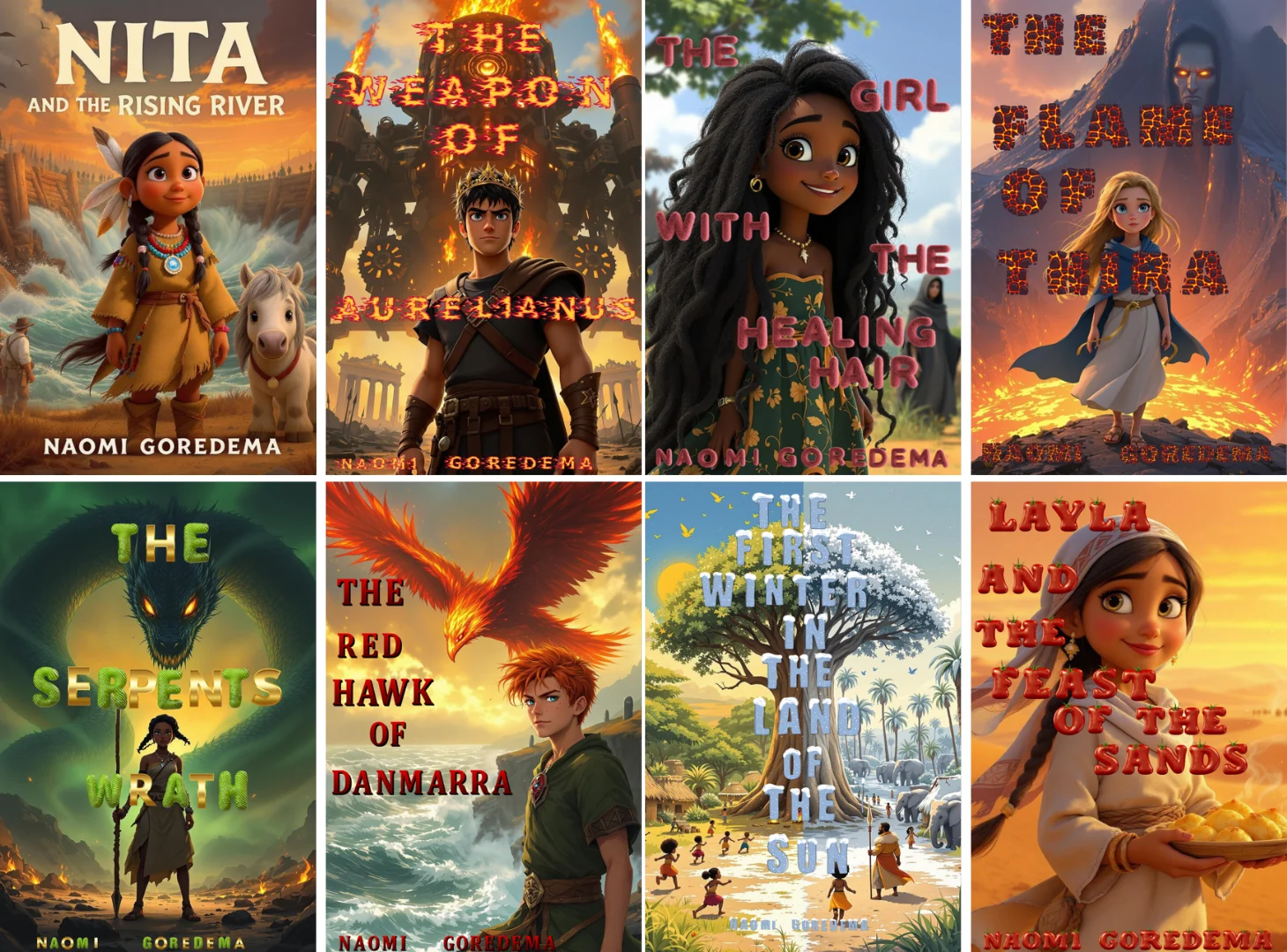
Eight published children's book covers illustrated with Neolemon

Not only children's books

Sarah designs cartoon characters from the real animals at her rescue shelter and turns them into adoption campaigns. Erica built an 8-scene rom-com storyboard with full multi-character interactions. Lisa Foreman published Wonderfuller, illustrated entirely in Neolemon.

Across third-party platforms, Neolemon sits at 4.5 on Trustpilot with 94% 5-star, and the Maven course holds 4.8 from 91 reviews.

For Amazon KDP authors

The use case we rebuilt around.

Roughly 60% of our users are KDP publishers. If you're publishing a children's book on Kindle Direct Publishing, three real concerns rarely make it into a generic "best Midjourney alternatives" listicle.

1

Continuity across 24 to 32 pages

The bottleneck isn't a beautiful picture of a kid. It's whether page 1, 8, 17, and 31 are the same kid: same face, hair, outfit, proportions, and style. Our documented 15-scene workflow generates consistent illustrations in under 10 minutes from a single front view. Complex group scenes still need iteration, and we don't promise perfection.

2

KDP's AI-disclosure rule

Amazon KDP requires you to disclose AI-generated content when publishing, including cover and interior images. That's true whichever tool you used. Midjourney, Neolemon, or anything else. Neither one exempts you from disclosure.

3

Print specs are still on you

Both tools make digital images. Neither hands you a print-ready KDP interior. KDP needs at least 300 DPI, and full-bleed interiors must extend 0.125" past trim. Our free upscaling and Storyboard PDF help you plan, but final trim, bleed, margins, and proofs still happen in your layout tool.

A straight word on copyright

The U.S. Copyright Office's 2025 AI report says AI outputs can be protected only where a human author contributes sufficient expressive elements, and that prompts alone don't provide enough human control. "Commercial use is allowed," which both Midjourney and Neolemon grant on paid plans, is not the same as "you own the copyright." Talk to a lawyer before betting a brand or a book series on it.

Where we're not the answer

When to pick something else.

We'd rather send you to the right tool than keep a user who isn't a fit. Here's the honest reverse-recommendation.

Use Midjourney (or another general model) if

  • You want photoreal humans for editorial, fashion, product, or brand work.
  • You're doing broad fantasy, sci-fi, cinematic, or surreal concept art.
  • Your project is anime and you want Niji 7 specifically.
  • You want native image-to-video without a separate tool.
  • You want maximum aesthetic exploration on a budget. Standard's unlimited Relax is hard to beat for volume.

Going through Adobe apps? Use Firefly. Need text rendered inside the image? Ideogram. Want LoRA training and open-source control? Stable Diffusion or Flux.

Use Neolemon if

  • Your job is recurring cartoon characters across multiple scenes.
  • You're making storybooks, comics, classroom stories, or KDP picture books.
  • You need the same character to come back, page after page, on-model.
  • Your real cost in Midjourney has been retries chasing consistency.
  • You want a free trial before you commit, and a web app with no Discord.

This is the deciding reader for most people who land here. If that's you, the next step costs nothing.

Three ways to work

However you want to switch.

Whether you're starting fresh, already deep in Midjourney, or planning to animate later, here's the practical path.

Workflow A

Neolemon, from scratch

  • Sketch your character in Character Turbo using the structured fields.
  • Pick the front-view image as your anchor.
  • Generate scenes with Action Editor, adjust with Expression Editor.
  • Compose with Story Scene Pro, assemble in Storyboard or AI Canvas.
  • Lay out for print in Affinity, InDesign, Canva, or Vellum.

Workflow B

Midjourney plus Neolemon

  • Use Midjourney for moodboards, style direction, covers, and full-spread backgrounds.
  • Once the look is locked, use Neolemon to lock the character.
  • Produce interior pages where the same kid appears over and over.
  • Compose final layouts in your usual tool.

Honestly the best of both worlds for many authors. It's how creators like Naomi Goredema already worked.

Workflow C

Neolemon plus a video tool

  • Generate your consistent character and key scenes in Neolemon.
  • Feed selected frames into Higgsfield, Runway Gen-4, or Kling for motion.
  • Edit in CapCut, DaVinci Resolve, or your preferred editor.

We make consistent frames. Downstream tools handle motion. We don't pretend to be an animation studio.

Questions, answered straight

Frequently asked questions.

Can Midjourney create consistent characters?+

Yes, with caveats. It has Character Reference in older versions and Omni Reference in V7, which can carry a character, object, vehicle, or creature into new generations. The constraints, per Midjourney's own docs: V7 only (not V8.1), one reference image, 2x GPU cost, incompatible with Vary Region, Pan, Zoom Out, Fast, Draft, and --q 4, and small details like freckles or logos may not match. It helps. It's not a dedicated storybook workflow.

Is Neolemon better than Midjourney?+

For making the same cartoon character recognizable across many scenes: yes, that's our entire product. For making the most aesthetically impressive one-off image: no, Midjourney is genuinely brilliant at that and we don't pretend otherwise. They're optimised for different jobs.

What's the best Midjourney alternative for consistent characters?+

If your job is the same cartoon character across many scenes, children's books, comics, classroom stories, mascots, social storytelling, Neolemon is built for that specific job. If your job is broader image generation, Leonardo, Adobe Firefly, Flux, or Ideogram are all reasonable choices depending on what you're optimising for.

Is there a Midjourney alternative without Discord?+

Yes. Neolemon is a web app, no Discord required. Midjourney has a web app too now, but its workflow culture is still heavily on Discord, and a lot of the prompt-sharing and inspiration lives there. If Discord is a dealbreaker, Neolemon, Leonardo, Adobe Firefly, and Ideogram are all browser-only.

Can I use Midjourney for KDP children's books?+

You can, and many authors do. Two things to know: Amazon KDP requires you to disclose AI-generated content when publishing, including cover and interior images; and keeping the same character recognizable across 24+ pages is the hardest part, which is where Midjourney's reference tools start to feel like overhead. The honest answer: Midjourney for covers and backgrounds, Neolemon for interior character continuity.

Does Midjourney have an API?+

Generally, no. Midjourney's Community Guidelines say that, with rare explicit exceptions, it doesn't provide an API and prohibits automation. Neolemon's character model is available as a developer API through Segmind, consistent-character-AI-neolemon-v3, for teams that want to build on top of it.

What should I use for photorealistic characters?+

Not Neolemon. We pivoted away from photorealistic styles in May 2025 and now focus entirely on cartoon and illustrated styles. For photoreal humans, Midjourney, Flux, or general image models are the right call. We point users there ourselves.

What if I need multiple characters in the same scene?+

Neolemon has two workflows: Multi Character V2 (two characters, currently square aspect ratio with Reframe for other shapes) and Story Scene Pro (1 to 3 character references plus a background). Three or more characters in one frame still pushes current AI limits, so expect iteration. Midjourney's Omni Reference accepts one reference image and asks you to describe additional characters in text, which is less structured.

What if I need animation or video?+

Neolemon makes consistent frames, not motion. We recommend animating downstream in Higgsfield, Runway Gen-4, Kling, or HeyGen, then editing in CapCut. Midjourney has V1 Video that turns a still into a 5-second clip (extendable to about 21 seconds), but its video docs note that Omni Reference and Character Reference aren't compatible with video generation. So making a character consistent with Omni and then animating it with the same controls doesn't currently work in Midjourney either.

Can I use Neolemon images commercially?+

Yes. Paid plans include commercial-use rights. Two things to keep in mind: commercial use is not the same as copyright ownership (see the U.S. Copyright Office's 2025 AI report), and AI-generated images need to be disclosed on Amazon KDP if you're publishing there. Both are true for every AI image tool, not just Neolemon.

Is there a free trial?+

Neolemon gives you 20 free credits with no card required, enough for around five Character Turbo generations. Midjourney has no free trial on web or Discord; the only limited trial is via the Niji mobile app.
If your project is one beautiful image, stay with Midjourney.

If it's the same character on page 1, page 8, page 17, and page 31 of the same book, try us. Character Turbo to anchor identity, dedicated editors to vary the scene, and a workflow that takes you to a finished book.

Creator Plan $29/month for 600 credits. No card to start.